 Every Las Vegas Raiders player in the NFL 1000, graded and ranked by the B/R Scouting Department. Search the list or cut it by position. Rookies to be graded separately.Player photos: AP Images
995LV 29 DJ Glaze51Grade
Glaze played every snap in 2025 inside a subpar Raiders environment, where a lethargic run game and frequent obvious passing situations lowered the floor of the entire offensive line. Glaze was particularly exposed in protection, where below-average movement and redirect skills led to too many glaring losses against higher-end rushers. He's a big-bodied, thick tackle with solid play-strength and flashes of halting power, but erratic pad level and strike-timing expose his chest, sap his leverage and create shaky body control. In the run game, Glaze has the dimensions and raw strength to cover up targets and create displacement in spurts, though his technique remains unrefined. His 2025 tape was mediocre. However, a more stable, offensive line-friendly structure under head coach Klint Kubiak offers some room for improved functionality this fall.
976LV 28 Dont'e Thornton54Grade
Dont'e Thornton is an explosive, deep-threat wide receiver with prototypical height. The Raiders' 6'5 pass catcher has the top-end speed to glide past defenders if unimpeded like a Gazelle in the jungle. Thornton was a very raw prospect coming out of Tennessee, and his rookie season proved that. He caught 10 of his 30 targets but lacked nuance as a route-runner and suffered a few drops. He is a toolsy developmental receiver who needs more work to refine his game.
957LV 27 Adam Butler56Grade
The best season of Butler's career came in 2024, when he was a regular starter for the first time and had his most impressive performance as a run defender to date. However, he regressed last year, and the eight-year veteran has primarily been a sub-package player throughout his NFL tenure. Butler is really effective on line games, at both setting up teammates and himself to get pressure, and can rush from multiple alignments. But he shouldn't be asked to do much more than that.
948LV 26 Benito Jones56Grade
Jones is a pure nose tackle who has impressive strength at the point of attack to reset the line of scrimmage and make tackles near the line of scrimmage occasionally. However, he isn't consistent at holding his gap and doesn't offer much as a pass-rusher.
936LV 25 Jack Bech57Grade
Jack Bech is a compact-built receiver who plays at his own pace. His routes are run with good tempo and rarely give defensive backs indicators of his breaks. He worked well out of bunch and stack sets, where he can operate with a free release. Bech is not an overly creative playmaker after the catch, but he understands the importance of quickly transitioning to a runner. He has athletic limitations that could limit his developmental ceiling.
933LV 24 Jonah Laulu57Grade
Laulu has a good combination of strength and athleticism that has allowed him to show flashes as both a run defender and a pass-rusher so far in his career. But the two-year pro lacks consistency, especially against the run, to be considered a bona fide starter in the NFL moving forward. This feels like the make-or-break campaign for Laulu, going into year three with a chance to prove himself on Las Vegas' thin defensive line.
812LV 23 Thomas Booker IV62Grade
Last year was the first time Booker was a regular starter in the NFL, and he showed some promise as an interior pass-rusher. The 2022 fifth-round pick has decent strength to push the pocket and some quickness to work the edges, collecting a handful of wins/pressures despite not appearing in the sack column. Booker still has a lot of work to do against the run, though, often getting blown off the ball.
809LV 22 Caleb Rogers62Grade
Rogers entered the Raiders' lineup in Week 13 and started the final six games, putting enough tape together to compete for the full-time job in Klint Kubiak's system. The 2025 third-round draft pick is a sawed-off, sturdy guard with solid play-strength, good power, above-average movement skills and a fiery, physical demeanor. Those traits showed up through a jarring punch, pocket-clearing force when uncovered, the burst to uproot down linemen and enough range to intersect targets on the move. The second-year blocker must refine his technique, though. Raw footwork and rigid hand usage limited his ability to adapt and recover when isolated in protection, while leading to overextension and shaky balance on base and angle-drive blocks. Rogers' physicality, traits and improved ecosystem give him a viable path to earning a starting job, but his technique must stabilize.
776LV 21 Jordan Meredith63Grade
Meredith started 11 games in 2025, primarily at center, with two starts at left guard in Weeks 10 and 11 before a season-ending ankle injury. Meredith is a sawed-off interior blocker with a stiff, jarring punch, solid play-strength and an attacking mentality. He plays low to the ground and can function as a sturdy point-of-attack blocker when defenders are within his frame. A lack of length and short-area quickness are limiting factors, though. His lack of reach shows up when isolated against hulking rushers, as it did against Quinnen Williams and Kenny Clark in Week 11 last year, while his middling range caps his ability to line up targets on the move. Meredith could survive as the fifth-best starter on a good line, with real value as a swing interior backup.
702LV 20 Kirk Cousins64Grade
The Atlanta Falcons never received the ROI they expected after signing Kirk Cousins. Over the two years in Atlanta, he started 22 games, throwing for 28 touchdowns and 21 interceptions. Cousins still processes information well, identifying blitzes and pressure packages pre-snap. When defenses sent extra defenders, Cousins found his open target. At this stage of his career, there is little physical upside with Cousins. His arm strength has declined, and he will not offer anything as a scrambler.
682LV 19 Spencer Burford65Grade
Burford started nine games in 2025 sandwiched around a six-game absence due to a knee injury, putting enough functional tape together to enter training camp as a potential starter for the Raiders. Burford is still a little light with a below-average anchor, and his erratic processing can leave him a tick late sorting games, stunts and late movement. However, he has excellent length, solid strike-timing and enough hand pop to establish first meaningful contact, disrupt rushers' timing and stay square in his sets to minimize clean edge losses. His marginal play-strength can still lead to compression against power, but improved snap-timing helped him cover up and seal targets on backside cutoffs while adding pop in the post on combination blocks. A reunion with Klint Kubiak, after a year together with the San Francisco 49ers, gives Burford a favorable runway to compete for a starting job, while maximizing his strengths in an offensive line-friendly structure.
646LV 18 Jackson Powers-Johnson66Grade
Powers-Johnson settled at right guard to open the 2025 campaign after splitting time between center and left guard as a rookie. His second year was cut short by an ankle injury after seven starts. His tape remained a mix of promising physical flashes and raw technical execution. Powers-Johnson has a sawed-off, stout build with enough play-strength to firm up the point of attack, along with fluid movement skills to redirect and work himself out of some compromised positions. He is also a force when uncovered in pass protection, where his power and demeanor allow him to clear the pocket and punish adjacent rushers. The volatility shows up when isolated against quality interior rushers. His unpolished footwork and hand usage can create quick losses across his face, and his aggressive temperament still leads him into bad positions when he overshoots his landmarks or chases contact without control. In the run game, his strength, movement and finishing demeanor create flashes of a tone-setting guard, but the down-to-down precision still needs to improve. The 23-year-old's physical traits and age leave him with a clear runway to become a solid starter, especially inside a Klint Kubiak system. At this point in time, his current profile remains more projection-based than stable.
592LV 17 Darien Porter67Grade
While Kyu Blu-Kelly saw the majority of reps opposite Eric Stokes until Week 11 and was getting lit up, Darien Porter's time had to wait. He got his opportunity after Blu-Kelly was benched against the Cowboys and started every game the rest of the season. The athletic ability and pure talent are off the charts, and while he committed more penalties than you'd like, Porter got better as the season went along. Flashing the closing speed, ball skills, and press-man coverage that got him drafted, Porter has set the stage for a breakout year two in Las Vegas.
574LV 16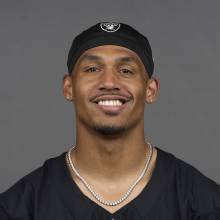 Isaiah Pola-Mao68Grade
Forced into playing more post-safety than he was comfortable with in 2025, Isaiah Pola-Mao struggled to find his footing. An early-season injury to Lonnie Johnson put more on Pola-Mao's shoulders, and the comfort from deep never came to fruition, but down the stretch, with more reps closer to the line of scrimmage, he started to turn it around. He shows good play recognition and a feel for coverage as a two-high or intermediate defender, but is better as part of a safety rotation. Putting too much on his plate overcomplicates his role.
568LV 15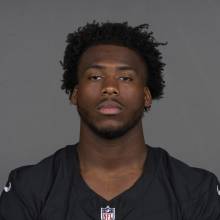 Malcolm Koonce68Grade
At the conclusion of the 2023 campaign, Koonce looked like he was in line to receive a big payday. He had eight sacks in the last nine games of the season to build some momentum heading into a contract year, only to see it all go for naught by tearing an ACL about a week before the 2024 season opener. The injury impacted the Buffalo product's explosiveness a year ago, which is the root of his game. Koonce has a second chance to prove himself in Las Vegas this fall, but it remains to be seen if he can get back to his pre-injury form.
500LV 14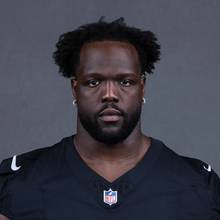 Kwity Paye69Grade
Paye is an interesting pass-rusher because he has the traits to become a very good one and had a three-year run where he recorded 22.5 sacks from 2022 to 2024. However, he's still pretty one-dimensional, relying heavily on winning with power, and is coming off a down season by tying his career low with just four sacks. The 2021 first-round pick is a good edge-setter against the run and has the strength to defeat blocks to make tackles for short gains, though. It's just a matter of whether he can turn the corner as a pass-rusher to live up to the pre-draft hype.
499LV 13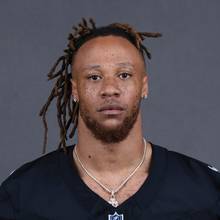 Eric Stokes69Grade
In a corner room that lacked a steady presence, Eric Stokes brought that to the table in 2025. Better in zone coverage, where he can drive down on routes or stay on top of them, Stokes was great in limiting yards after the catch last season and put himself in the right position to make tackles. He read out run plays and quick screens well and was a willing participant to help stop them when needed. Stokes could have had more ball production, but his punch timing was a tick slow and allowed conversions he'll want back. After a rough stretch in his career recently, Stokes bounced back well for a Las Vegas team that needed his presence.
470LV 12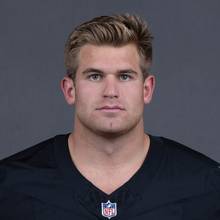 Michael Mayer70Grade
Having multiple starting-caliber tight ends on an NFL roster is becoming a necessity, and Michael Mayer makes that possible in Las Vegas. Filling the role of the "Y" tight end, he's grown as a functional blocker as an NFL player, but still needs to work on lowering his head and scooping. When Brock Bowers missed time last season, Mayer was able to handle more routes, and while he isn't the route-runner Bowers is, he uses some route nuance (head intention and hands at the top of routes) to create separation and is a tough runner after the catch. New head coach Klint Kubiak will want to utilize 12 personnel, and with Mayer entering a contract year, he could be in for a nice season.
438LV 11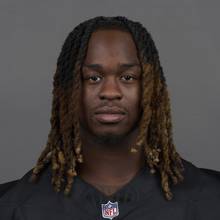 Ashton Jeanty70Grade
Jeanty's rookie campaign epitomized the phrase "Hard Knocks." Behind a subpar offensive line, he had to display toughness and grit to earn hard-fought yards. Jeanty's game is built around elite contact balance, physicality, vision, and patience. When the offensive line opened running lanes, his powerful/slashing running style was on display. Jeanty is a finisher who welcomes contact and will dish out everything he receives. He showcased his receiving skill set out of the backfield, increasing his value going forward. Jeanty's pass protection graded out negatively. Meanwhile, his vision on runs between the tackles was inconsistent. He ran into the back of his blockers; he processes information more quickly with zone-running concepts.
437LV 10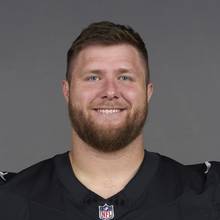 Kolton Miller70Grade
Miller started only four games in 2025 before a Week 4 high-ankle sprain and hairline fracture in his right ankle ended his season. The limited sample size makes this more of a health-discounted evaluation than a clean full-year reset, especially given Miller's prior track record as a quality left tackle. When right, Miller wins with size, length, functional athletic ability and a more refined pass-protection approach than his 6'8" frame suggests. His best reps come when he can use his hands to disrupt pass-rush timing, protect his frame and force defenders to work through his length rather than win quickly around the edges. The 2025 injury context clouds how much of his movement and anchor can be cleanly projected, but his history points to a solid starter when healthy. In the run game, Miller can still cover up, create angles and generate functional movement, though he is not a consistently dominant displacement blocker. His current grade reflects a proven tackle whose recent availability and lower-body recovery create uncertainty. However, his baseline traits and body of work still support a solid starting profile if his ankle fully rebounds.
388LV 9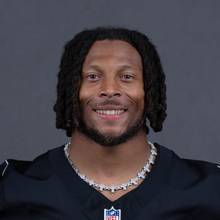 Tre Tucker72Grade
Tre Tucker is one of the more underrated receivers in the league. Don't let the shorter stature of Tucker fool you; he plays bigger and tougher than his 5'9 frame. He is a willing participant in the run game as an insert-blocker seeking out linebackers and safeties to create creases for the running back at the second level. In the passing game, Tucker aligns all over the formation, beating man and zone coverages. His 4.4 speed is effective in attacking the vertical plane and keeping corners on their toes. Tucker is effective working underneath as a quick passing target. He showcases good post-snap coverage recognition and weaves through zone defenses into the void. A revolving door at the quarterback position has limited Tucker.
363LV 8 Jeremy Chinn73Grade
Jeremy Chinn wears so many different hats for the Raiders defense that he should be called the Mad Hatter. That kind of usage makes it difficult to hang his hat on any one thing, but he racks up a ton of tackles with his effort and willingness to play against the run. He's better at sorting through the trash than stacking and shedding blocks, but he gets involved. In coverage, his eyes can wander and concentration lapse, leading to coverage busts, but his athletic ability, big nickel tools, and versatility keep him on the field.
353LV 7 Jalen Nailor73Grade
Jalen Nailor served as the WR3 for the Minnesota Vikings offense. He is a smart route-runner, finding ways to get open against various defensive looks. Nailor's hands are reliable for securing passes on and off his frame. He does a good job working back to the quarterback and settling into the holes inside the coverage shell as an open target. Nailor's ball skills and tracking should come in handy with the Las Vegas Raiders this season.
324LV 6 Quay Walker74Grade
Walker might be the most frustrating linebacker in the NFL. At 6'4" and 241 pounds with a 9.63 Relative Athletic Score coming out of Georgia, the former Bulldog has the size, strength and athleticism to be a well-rounded backer. Those traits show up in spurts to at least show that he's a starting-caliber player, but the consistency isn't there yet, and it's because he's still figuring out the mental aspect of the position, especially in coverage.
272LV 5 Nakobe Dean75Grade
Injuries have been the biggest factor holding back Dean's career. On the field, he's a highly instinctual run defender who is constantly making stops, and he has the acceleration to be effective at closing in coverage. Also, the former Georgia Bulldog is an excellent blitzer, destroying running backs in pass protection to rack up seven sacks over the last two seasons. The 5'11" linebacker's lack of length limits him in coverage, especially in man coverage, as he doesn't have good ball skills and is susceptible to giving up yards through the air, though. Also, as alluded to above, he's struggled to stay healthy and has missed 25 regular-season games in just four years.
266LV 4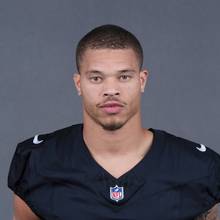 Taron Johnson75Grade
Quietly giving up the fewest yards in coverage since his rookie season, Taron Johnson was an excellent zone defender for the Bills' defense this past year. While the ball production regressed, he was in better positions to make tackles and limit yards after the catch. His man coverage skills are hit and miss, and he will bite hard on play action fakes from time to time, but watching him drop into zone, pick up routes with his eyes, and trigger underneath is enjoyable to watch. He should be a steadying presence in Buffalo's secondary in 2026.
118LV 3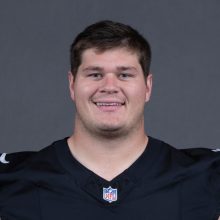 Tyler Linderbaum81Grade
Linderbaum will enter the 2026 campaign as a very good, scheme-dependent starting center whose value is driven by rare movement skills and high-end run-game impact. He is at his best in zone concepts and working on the move, where his quickness, range, leverage and angle control allow him to reach landmarks, create displacement and unlock second-level access. Linderbaum's athletic profile remains among the league's better center-specific traits. His processing, balance and natural leverage help him punch above his weight class. Pass protection can be problematic, because his smaller frame and compact build create a thinner margin when isolated against high-end interior rushers. He can be compressed by power and presents softer edges when forced to anchor without guard help. Despite those concerns, the three-time Pro Bowler has the leverage, balance, recovery athleticism and functional strength to keep him from becoming a liability. Linderbaum is not the most physically imposing center, but his movement skills and run-game range give him clear high-end starter value.
72LV 2 Brock Bowers85Grade
Brock Bowers is one of the best weapons in the NFL and can win in a multitude of ways against a variety of opponents. He's smart enough to dissect zone defenses pre- and post-snap and crafty enough to beat man coverage with intentional routes. The different ways he can catch the football with the radius and tracking ability he possesses are special; add to it his quickness to get up to speed after the catch, and it's easy to see how impressive he is. The former first-round selection dealt with some injuries last season that kept him sidelined, but when he was on the field, the impact was there. As Bowers continues to grow, he's only going to be more difficult to defend.
61LV 1 Maxx Crosby86Grade
While Maxx Crosby's pass-rush production has dipped over the last two seasons, his hand-swipe move and relentless motor remain top-notch. Also, he still accumulated 10 sacks in 2025. A lack of surrounding talent in the Raiders' lineup should be attributed as part of the reason for his drop in numbers. Las Vegas lacks a notable bookend or interior pass-rusher to take the pressure off the five-time Pro Bowler. Conversely, Crosby can make a strong case as the best run-defender working off the edge. He displays the strength to establish contain, and his elite get-off leaves blockers grasping at air while the "Condor" collects tackles for loss, accumulating 90 TFLs over the last four seasons. As such, Crosby is easily one of the league's more disruptive players.